Artifact 5 - Managing Off-Task Behavior in a Classroom
AECT Standard 3: Learning Environments
Context and Conditions
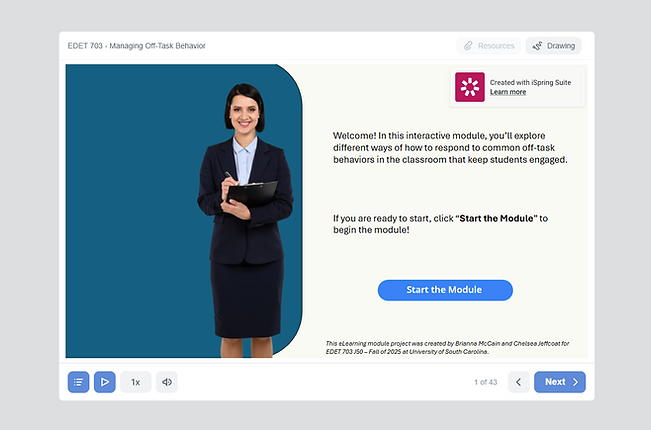
The artifact, Managing Off-Task Behavior in the Classroom, was a eLearning product developed in my graduate course in EDET 703 in learning designs and technologies at the University of South Carolina. The project was completed as part of Kuhlmann’s 3Cs scenario-based eLearning module. The project was built around how to manage off-task behavior, classroom management, and student engagement challenges in the classroom. During this time, I was strengthening my skills in multimedia design, effectively chunking instructions, and student-centered learning. When developing this artifact, I approached this project with a foundational knowledge of classroom management practices and some knowledge of digital lesson development.
The project was developed and designed in Microsoft PowerPoint with the integration of iSpring and used RocketCakes to publish an interactive learning experience. During the design process, we focused on using the ADDIE model (Branch, 2009) and the Morrison, Ross, and Kemp model (Morrison et al., 2013) to help conduct the needs analysis of the project, the learning objectives, and design. Additionally, we focused on Kuhlmann’s 3C model scenario (Kuhlmann, 2009) that created a framework to build a structure for branching practice and feedback. Furthermore, our design for minimizing cognitive load with the be combination of Mayer’s Multimedia Principles (2009) and the Cognitive Load Theory (Sweller, 1988). With the integration of all the models, we were able to develop an authentic, self-paced, interactive eLearning module about managing off-task behavior in the classroom.
Scope
The purpose of this artifact was to develop a scenario-based learning module that followed Kuhlmann’s 3Cs model for an instructional design course at the University of South Carolina. The scenario-based learning module was based on providing practical ways to manage off-task behavior in the classroom settings. While the artifact was developed as a singular resource tool, this eLearning module could be built into a larger curriculum as a resource for teachers for classroom management skills or student engagement strategies that represent a fully developed instructional model with learning objectives, scenario-based practice, feedback, and design elements that align with Bloom’s Taxonomy. The artifact allowed me to reflect on how to apply classroom management skills into scenario-based experiences, how to apply the ADDIE model into the development of a module, and strengthen my skills on student centered learning. One thing that I needed to learn during this project was what Kuhlmann’s 3Cs were and how to apply it to the module.
Role
During this project, I was placed on a group project with one other graduate student. The role that I played was one of two instructional designers and developer of the artifact. While there were no real subject matter experts (SMEs) involved in the development or evaluation for this project, my partner had several years of experience working in the public elementary school environment to provide expert advice and knowledge on this topic. The role that I played in this creation was helping create a needs analysis on classroom management, prototype site maps, and interactive learning module that allowed me to organize, sequence, and create a visual layout. Furthermore, I put together the final interactive presentation and coded the final project into a website for the University of South Carolina graduate students.
Instructional Design
This artifact was able to reflect both elements of the ADDIE model (Branch, 2009) and the Morrison, Ross, and Kemp model (Morrison et al., 2013). With this artifact, the analysis, design and development phase from the ADDIE model was the strongest alignment. During the analysis phase, my partner and I identified that there was a need to develop practical classroom management skills to manage off-task behavior for new and developing teachers. By understanding there is a need for ways to manage off-task behavior for new and developing teachers, we could find a solution to this need.
This artifact aligns with the design phase in the ADDIE model because after we gathered from the needs analysis information, we were able to design learning objectives, instructional materials, multimedia, and assessments that align back with learning objectives. We focused on creating a blueprint to layout the eLearning module to figure out what learning objectives will be used, the multimedia, assessments, instructional materials. The artifact also aligns with the development phase in the ADDIE model. We focused on developing the product that incorporated the practice scenarios, interactive navigation structure, visual hierarchy, and the embedded feedback mechanisms for the learner to use.
The artifact aligns with Morrison, Ross, and Kemp (MRK) instructional design model by focusing on aim goals were to develop measurable ABCD learning objectives that aligned with Bloom’s Taxonomy, ranging from level 2 (to understand) through level 5 (to evaluate). For example, we also intentionally focused on instruction sequencing to allow the learner to go through three challenging scenario-based examples at the learner’s own pace, ensuring that the learner was being provided with practice opportunities and feedback that align back to the learning objectives. Additionally, for the message design from the Morrison, Ross, and Kemp model, it was evident in the intentional use of a realistic background of a classroom setting, cues for dialogue, and color coding to support and guide the learner’s attention throughout the lesson and lower the cognitive load when learning.
Additionally, our product had embedded the branching structure, “Challenge-Choice-Consequences,” that aligned with Kuhlmann’s 3C model, which develops a structure for the learner to build an understanding of classroom management skills with the emphasis on authentic learning through decision making. When developing our layout, we focused on the principles from Mayer’s Cognitive Theory of Multimedia Learning (Mayer, 2009) and the Cognitive Load Theory (Sweller, 1988). By focusing on those principles, it helped create a simplistic structure for the product, limit animation that would not distract the learner, and finally, meaningful text and visuals to support the learner’s experience. Unfortunately, the eLearning module never went through formative evaluation with a group of teachers or an SME during the evaluation phase. The artifact does provide a strong foundation that aligns with learning objective goals, effective and intentional instructional strategies implementations, and feedback for the learner.
Related Performance Indicator
Collaborative Practice - Candidates collaborate with their peers and subject matter experts to analyze learners, develop and design instruction, and evaluate its impact on learners.
Reflection
This artifact represents my ability to strengthen my ability to work in a group to collaborate with my peers to analyze and develop and design instructions. Unfortunately, we could not evaluate the impact of our eLearning module into a real-world setting, but this connection reflects on AECT Standard 4.1 with being able to work together with peers to create effective, real-world scenario-based instructions to improve classroom management skills.
While I am still in the learning stage, I recognize my partner and I have several opportunities to enhance our final product. If I had the opportunity to change or enhance this product design, I would focus on incorporating more accessibility features specifically with alternative text and screen reader testing. Looking back at this design and now taking EDET 735, redesigning with the focus of Universal Design for Learning (UDL) would strengthen the usability of the product and gather true performance data beyond the embedded feedback that is built into the product.
Overall, there are a lot of opportunities to improve this artifact. It represents a milestone in my growth of my work as an instructional designer student. Because of this experience, it has allowed me to develop a strong grasp on my understanding of how instructional design models work, particularly with the ADDIE model. Also integrating the Morrison, Ross, and Kemp model, to help develop effective student-centered digital instructions to provide an authentic learning experience.